
Note: To protect our students' privacy, names and identifying details have been changed. The story below is based on real experiences from our workshops.
She was eleven. We'll call her Ananya.
She walked into our Mandala Art workshop with more excitement than confidence. One of the youngest students in the room, she had a question for almost everything.
"Are we really making this?" "What if I spoil it?" "Will mine look like yours?"
She couldn't wait to begin. She was also quietly worried about getting it wrong. I've noticed that many children walk into an art room carrying that same worry. Not because they don't enjoy making things. Because somewhere along the way, they've started believing that art is something you're either naturally good at or not.
So before they've even drawn the first line, they're already looking around the room, wondering if everyone else is better. Adults do exactly the same thing. We've just become better at hiding it.
The first hour wasn't difficult because of the artwork. It was difficult because of the comparisons. Ananya struggled to stay with her own page. She'd glance at another student's mandala and quietly say, "I like hers." A few minutes later she'd call our facilitator over and ask, "Can you do this part for me?"
Not because she didn't want to learn. Because she genuinely believed someone else could do it better.
Our facilitator never took the pen from her. Instead, she smiled and said,
"We're all here to learn. If we don't make mistakes here, then where will we?"
There was no rushing to fix her work. Just another invitation to keep going. Something shifted after that. Not because her artwork suddenly became beautiful. Because she slowly stopped expecting it to be perfect.
Towards the end of the session, she looked at her mandala and quietly said,
"I know it's not a perfect art piece... but I tried."
— Ananya, age 11That sentence has stayed with me ever since. Because somewhere along the way, we've taught children that trying only counts if the result is beautiful. I don't think art works like that. And I don't think learning does either.
When the Artwork Became Hers
Something we intentionally build into every Maekido workshop is a gradual release of responsibility.
We begin by demonstrating. Then we create together. Eventually, students begin making their own choices. That's the moment we look forward to—not when every artwork looks beautiful, but when it starts looking personal.
By the third session, Ananya wasn't asking someone else to finish her work anymore. She was choosing her own colours, experimenting with patterns and trusting herself enough to make mistakes.
The artwork wasn't suddenly perfect. It was unmistakably hers.
When Learning Left the Classroom
The most memorable part of the workshop wasn't what happened in the room. It was what happened after. Children began taking unfinished pieces home because they genuinely wanted to continue working on them. The next day, they'd walk in excited to show us what they'd added the previous evening.
By the final showcase, the room was filled with hand-painted coasters, mirror mosaics, customised mugs and carefully assembled art portfolios—each one different, each one unmistakably personal.
The questions changed too. Instead of asking, "Can you do this for me?" they began asking, "What if I try this?", "Can I use another colour here?", "What do you think would happen if I...?" To me, that's what learning looks like.
"Ananya still asked for help. The difference was that she no longer wanted someone else to do it for her. She wanted someone to help her learn how."
A Room Full of Young Artists
One thing I'll remember from that week had very little to do with technique.
There is still a quiet belief that forms of art like dot mandalas or mirror mosaics are somehow "for girls." Our workshop didn't seem to care.
Pavan patiently refined every tiny detail of his artwork. Reyan approached every mirror mosaic piece with remarkable focus. Neither was concerned with whether the activity fit a stereotype.
They were simply absorbed in making. By the final day, several students weren't asking when the showcase would be. They were asking if the workshop could continue for another week.
Honestly... I wished it could too.
When the Tables Turned
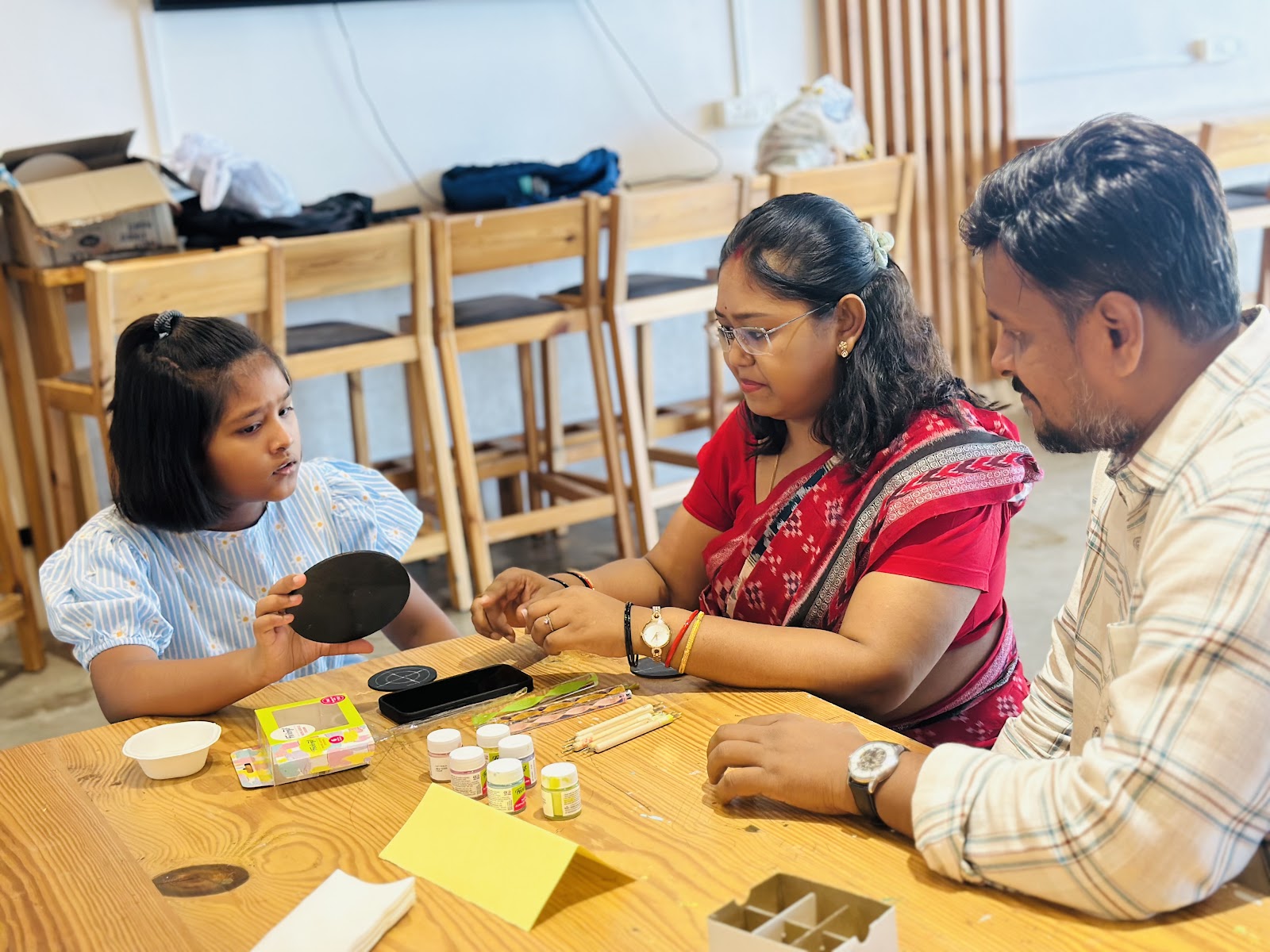
The showcase wasn't only about celebrating what the children had made. It was about reminding parents what it feels like to create.
So instead of simply admiring the artwork... We invited them to make some. For a little while, parents became children again. And the children quietly stepped into the role of teachers.
The room quickly filled with laughter, crooked circles and conversations that probably wouldn't have happened otherwise.
More Than Just Art
As the showcase came to an end, a few conversations stayed with me.
One parent shared that their daughter usually found it difficult to sit in one place for long. We had just watched her spend nearly three uninterrupted hours completely absorbed in her artwork.
Another smiled and said, "I've always wanted to explore different art forms. I just never found the opportunity. You should conduct these workshops for parents too."
It reminded me that perhaps we don't outgrow enjoying art. We simply stop making time for it.
Watching the workshop unfold also made me think about how much unnecessary pressure we place on creativity.
"I'm not artistic."
"Art isn't practical."
"It has to be perfect."
Children rarely arrive believing those things. Somewhere along the way, we teach them. What I remember from that week isn't perfect artwork.
It's children helping one another choose colours. Parents making their very first dot mandala. Students excitedly carrying unfinished pieces home because they couldn't wait to continue.
Art, to me, has never been about creating something beautiful. It's about slowing down, paying attention and giving yourself permission to make something—without worrying whether it's perfect. Perhaps that's where creativity begins.
One imperfect dot at a time.